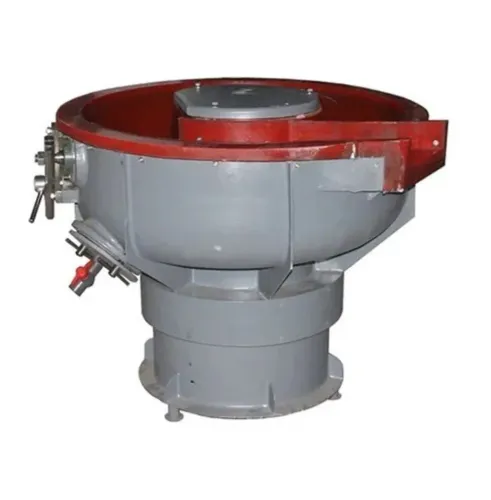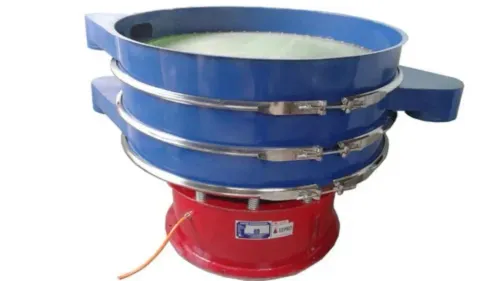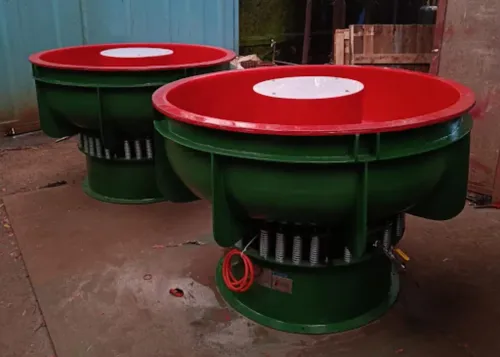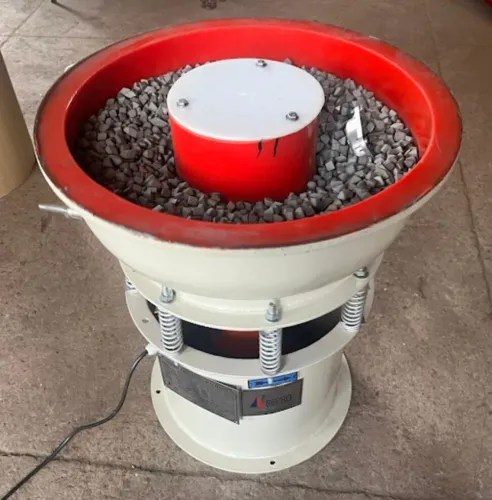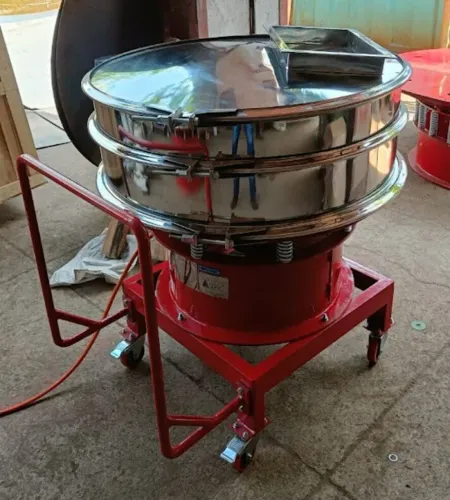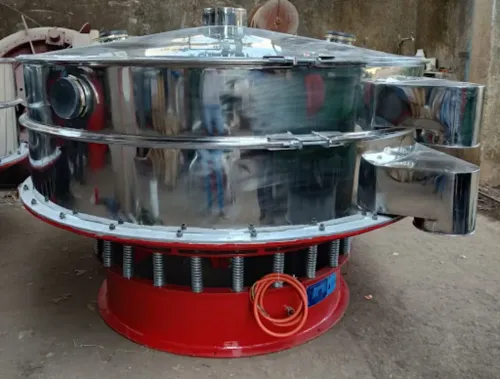
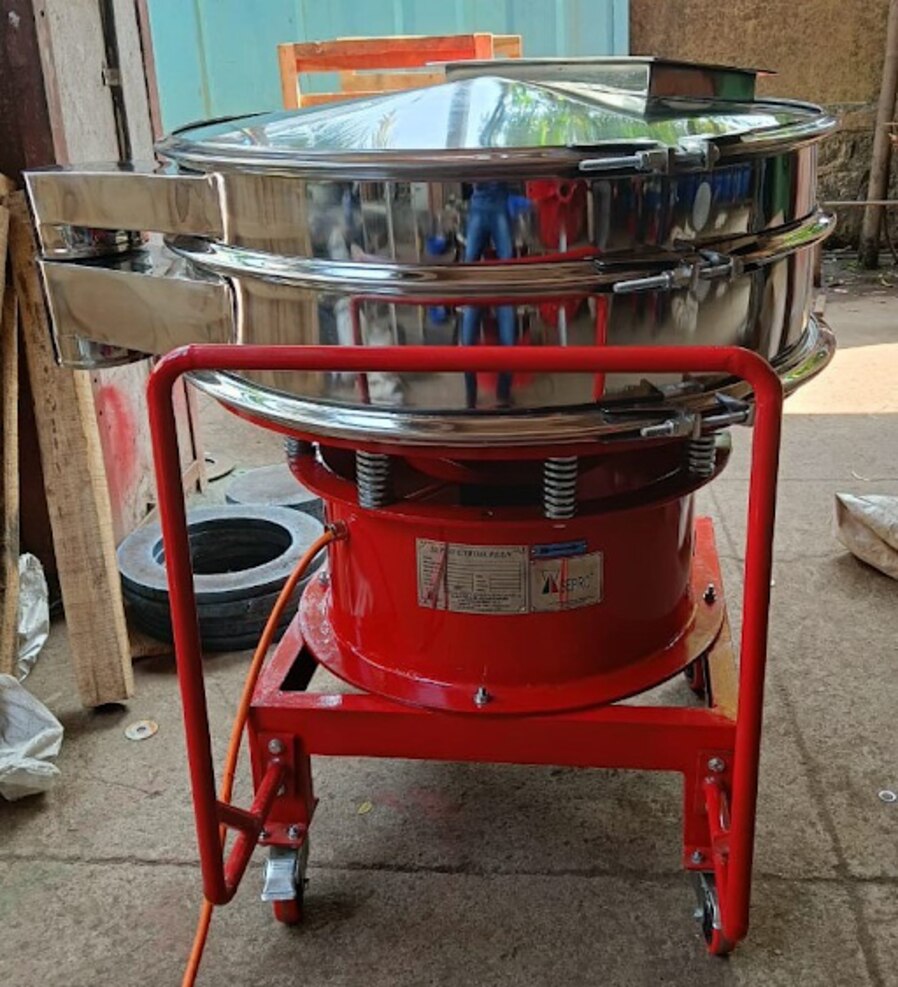
Chemical additives can arrive with oversized agglomerates, foreign particles, excess moisture, or a particle-size distribution that causes feeding and blending problems. By the end, you will be able to place screening correctly in the production line, define a workable separation target, choose operating settings, and judge when another process is more suitable.
Key takeaways
- Screen before dosing to remove lumps, oversize, and foreign particles.
- Match aperture size to the required pass fraction and contaminant size.
- Check powder flow, moisture, abrasiveness, dust explosibility, and chemical compatibility.
- Compare suppliers on trials, cleanability, containment, maintenance, and documented performance.
What problems does screening solve for chemical additives?
Screening separates chemical additives by aperture: particles small enough to pass through the screen become the pass fraction, while lumps, oversized particles, and foreign particles remain as retained material. Removing these contaminants before dosing reduces feeder bridging, mixer fouling, blocked conveying lines, dosing instability, and localized concentration variation caused by poor dispersion.
1. Load a representative sample onto the specified screen without overfeeding it. Record the aperture, screen type, sample mass, feed rate, vibration settings, and screening time.
2. Collect the pass and retained fractions separately. Weigh each fraction and inspect the retained material for oversized agglomerates, packaging fragments, metal, or other foreign matter.
3. Report the result as a particle-size distribution and screening analysis, stating the percentage passing and retained under those defined conditions. Do not present the nominal aperture as an absolute particle-size guarantee.
A 500-micrometre opening describes the hole, not a perfect 500-micrometre cut-off. Elongated, flaky, or weakly bonded particles can pass in one orientation and remain retained in another. Moisture can also make powder adhere to the mesh; reducing humidity exposure or breaking agglomerates may work better than increasing vibration.
Screening does not identify chemical composition or measure assay, moisture, purity, or degradation. A chemically incorrect additive can pass unchanged, so sieve control must be combined with identification testing or analytical tests such as assay and moisture analysis. It also cannot repair material that is inherently too fine, cohesive, or incorrectly formulated.
Where should screening sit in the powder-processing line?
Screening belongs wherever an oversized particle can disrupt the next operation: after receiving and drying to remove incoming lumps, after milling and blending to check distribution, and before feeding and packaging to protect dosing and pack consistency. Do not treat it as a single fixed position.
| Oversize route | Operating purpose | Use when |
|---|---|---|
| Controlled deagglomeration and recycle | Breaks soft lumps without deliberately reducing particle size | Retained material is clean, friable, and chemically suitable for reprocessing |
| Milling | Deliberately reduces particle size and changes the distribution | Oversize is hard, persistent, or outside the approved size range |
Follow a controlled sequence:
- Inspect and identify the incoming powder, checking its batch, condition, moisture, and foreign matter before loading.
- Load without overfeeding; a deep bed masks the mesh and pushes acceptable material into the oversize stream.
- Select the approved screen deck for the target opening and product-contact material.
- Control feed rate, vibration, and residence time so the powder has a fair chance to pass.
- Collect accepted fines and oversize in separate, labelled containers.
- Inspect the mesh after installation and operation for tears, blocked apertures, loose clamps, and distortion.
- Clean between batches, including mesh edges, clamps, gaskets, discharge chutes, and dust filters.
A loose clamp, failed gasket, open chute joint, or leaking filter creates a bypass path: oversize can enter the accepted fraction while the screener appears to run normally. Document mesh checks, cleaning, and any change to the deck or route.
How do you choose the screen and operating settings?
Choose the screen from the cut point and powder behaviour, then confirm it with a controlled trial; screen area alone cannot predict capacity. Specify the sieve opening in millimetres or micrometres, the micrometre particle size being targeted, mesh standard, wire diameter, weave, open-area percentage, material, and tension or mounting method.
The same mesh number can produce different openings when the wire diameter or standard changes.
- Use woven mesh for fine, precise separations and perforated plate for larger, abrasive particles or high-impact service.
- Select one screen deck for a single oversize removal; use multiple decks when you need sequential cuts and separately collected fractions.
- Define screen area, feed rate, vibration amplitude and frequency, screen inclination, and target residence time.
- Record bulk density, moisture, particle shape, agglomeration, and required recovery during trials; these determine practical capacity more than area alone.
| Screen choice | Strength | Main risk |
|---|---|---|
| Single deck | Simple, quick changeover | Cannot make separate size fractions |
| Multiple decks | Sequential grading in one pass | More retention points and cleaning time |
| Fine mesh | Better oversize rejection | Blinding, lower capacity, and product loss |
| Perforated plate | Durable and easier to clean | Coarser cut and lower precision |
Set acceptance limits for both maximum retained oversize and acceptable-product loss. A tighter cut can reject lumps while discarding usable powder. For fragile additives, inspect samples before and after screening for newly generated fines, especially after high amplitude, long residence time, or recirculation.
Report pass and retained fractions under defined conditions, not as an absolute particle-size guarantee.
Which powder properties and hazards change the machine design?
A cohesive powder can stick to mesh openings, causing screen blinding and pegging instead of separation. Moisture and hygroscopic additives intensify this failure, so control feed moisture and humidity, break lumps before screening, or use ball decks, sliders, or ultrasonic deblinding rather than simply increasing vibration.
| Powder property or hazard | Design response | Failure controlled |
|---|---|---|
| Cohesive, damp, or lumpy | Pre-breakup, controlled humidity, ball deck, slider, or ultrasonic deblinding | Blinding, pegging, blockage |
| Free-flowing or low-density | Adjust feed rate and vibration; use enclosed transfer points | Segregation and dust escape |
| Dry, low-conductivity powder | Ground and bond the machine; use conductive or dissipative components | Electrostatic charge and adhesion |
| Abrasive powder | Select wear-resistant contact surfaces and inspect mesh frequently | Mesh damage and contamination |
| Fragile powder | Limit amplitude, impact, residence time, and recirculation | Product degradation and excess fines |
Bulk density changes capacity even when screen area stays constant. Excessive vibration can generate fines, so compare samples before and after screening rather than assuming higher amplitude improves recovery.
Combustible dust requires containment and extraction, ignition-source control, disciplined housekeeping, and explosion venting, suppression, or isolation where the risk assessment demands them. Directive 2014/34/EU covers equipment intended for potentially explosive atmospheres; Directive 1999/92/EC covers workplace zones and risk controls.
Do not accept “ATEX compliant” as a complete claim: request the equipment category, zone assumptions, dust group, temperature class, and conformity documentation.
When is screening the right choice, and how should you compare suppliers?
Choose screening when the problem is an oversized particle, lump, or foreign body—not a need to change the powder’s basic size. Screening versus milling matters: milling deliberately reduces particle size, while screening removes material outside an aperture range without crushing the accepted fraction.
| Option | What it does | When it applies |
|---|---|---|
| Screening | Separates by aperture | Remove lumps, oversize, or foreign matter while preserving particle size |
| Milling | Breaks particles down | Create a smaller target size or deagglomerate hard material |
| Air classification | Separates by aerodynamic behaviour | Produce fine cuts where density and airflow control matter |
| Centrifugal sieving | Uses controlled continuous rotor-assisted sieving | Maintain steady processing with enclosed, metered feed |
| Rotary and static sieving | Rotary handles moving bulk; static sieving checks material without active conveying | Choose rotary screening for gentle high-throughput handling; choose static sieving for simple, low-capacity checks |
Air classification can struggle with cohesive or electrostatic additives that do not disperse reliably. Rotary and centrifugal systems can damage fragile particles through impact or recirculation, while static sieving lacks capacity for production flow. Any dust-producing option needs containment, extraction, ignition-source control, and suitable explosion protection for combustible powders.
Compare suppliers against this checklist:
- Open product-contact surfaces, welds, seals, clamps, and discharge chutes for inspection
- Few retention points and documented cleanability between allergenic or potent additives
- Changeover records, screen-inspection records, and traceable mesh identification
- Enclosed transfer, dust extraction, grounding, and defined containment performance
- Documented trials covering capacity, recovery, fines generation, cleaning, and contamination risk
Ask Separation Engineers (India) to evaluate these records and trial results, not just catalogue capacity.
Related product
 | Vibrating Screen Chemical Additives Screening Machine Separation Engineers India introduces the Chemical Additives Screening Machine, designed specifically for efficient and precise screening of chemical... View product → |
Frequently asked questions
What problems does screening solve for chemical additives?
Screening removes lumps, oversized material, and foreign particles before dosing. This reduces feeder bridging, mixer fouling, blocked conveying lines, dosing instability, and poor dispersion.
Where should screening sit in a powder-processing line?
Place screening before the dosing or conveying step that is vulnerable to oversize material. The best location depends on where contamination enters, how the powder is transferred, and whether screening the final blend could damage product uniformity.
How do you choose the screen and operating settings?
Choose the aperture from the required particle-size cut, then check screen area, feed rate, deck configuration, vibration, and residence time through trials. Confirm that the screen passes the target powder without excessive blinding or damaging particles.
Which powder properties and hazards change the machine design?
Moisture, cohesion, particle size distribution, abrasiveness, bulk density, temperature, chemical compatibility, and dust explosibility affect the screen, contact materials, enclosure, seals, cleaning method, and grounding requirements.
When is screening the right choice, and how should you compare suppliers?
Screening suits powders that need a defined size cut or removal of occasional oversize contaminants. Compare suppliers using representative trials, throughput data, separation results, cleanability, containment, maintenance access, and safety documentation.