

Metal components often leave machining, casting, stamping, or fabrication processes with burrs, sharp edges, oxidation, machining marks, or uneven surfaces. These imperfections may appear minor, but they can affect assembly, handling safety, coating quality, appearance, and the consistency expected from finished components.
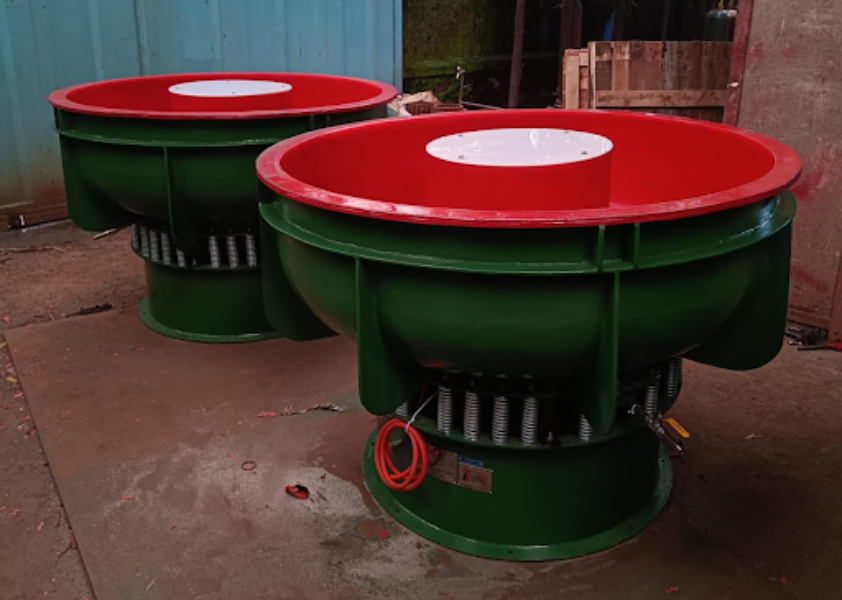
A Tumbler Finishing Machine provides a controlled method for improving component surfaces in batches. Parts are processed together with suitable finishing media and compounds, allowing repeated contact to remove unwanted material from edges and surfaces. Depending on the component and process parameters, tumbler finishing can support deburring, smoothing, cleaning, edge rounding, descaling, and polishing.
What Happens During Tumbler Finishing
The process is based on controlled interaction between the workpieces and finishing media. As the machine operates, components continuously move against the selected media. This action gradually removes burrs and surface irregularities.
The final result depends on several factors:
- Component material and hardness
- Size and geometry of the parts
- Type, shape, and size of finishing media
- Finishing compound used
- Machine operating parameters
- Processing duration
- Required surface condition
This is why two components made from the same metal may still require different finishing cycles.
Where Tumbler Finishing Adds Value
Batch finishing is particularly useful when manufacturers handle numerous small and medium-sized parts that would otherwise require significant manual finishing.
Engineering companies may use the process for machined components, stampings, castings, fasteners, fittings, hardware, and similar industrial parts. It can also help prepare components for subsequent operations such as coating, plating, painting, assembly, or inspection.
For manufacturing units in Navi Mumbai and other industrial areas of Maharashtra, reducing repetitive manual finishing can be especially valuable when production volumes increase.
Why Media Selection Matters
Selecting finishing media is not simply a matter of choosing an abrasive material. Media should reach the required surfaces without becoming lodged in holes, slots, cavities, or other component features.
Aggressive media can remove material faster but may be unsuitable when dimensional sensitivity is important. Finer media may provide a smoother finish but require additional processing time.
The right combination should therefore balance material removal, surface quality, cycle time, and component protection.
Consistency Is an Important Advantage
Manual deburring quality can vary depending on the operator, component complexity, and production volume. A properly established tumbler finishing process provides more repeatable conditions across batches.
This does not mean every component can be processed using identical settings. Trials are often needed to establish the appropriate media, compound, loading pattern, and cycle time.
Companies evaluating a finishing process should therefore begin with the actual component rather than selecting equipment purely according to machine capacity.
Understanding the Complete Finishing Requirement
Before implementing tumble finishing, production teams should define what they actually want to achieve. Removing a heavy burr requires a different process from producing a smooth cosmetic surface. Cleaning oxidized parts is different from preparing components for coating.
Separation Engineers work with industrial processing applications involving surface finishing and separation equipment. For engineering companies around Navi Mumbai and across Maharashtra, application-based equipment selection can help align finishing performance with production requirements.
A well-planned tumbler finishing process is ultimately about more than making metal parts look better. It can reduce manual handling, improve edge condition, support downstream operations, and provide greater consistency when finishing large batches of industrial components.