
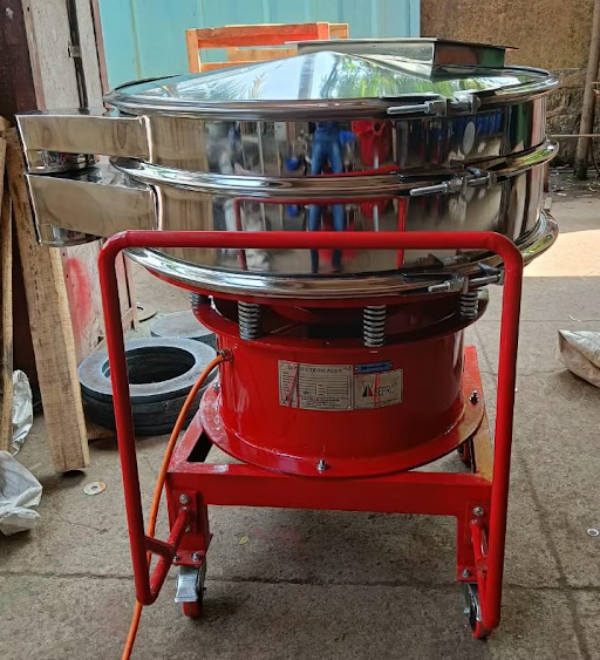
Chemical additives can vary significantly in particle size, density, flowability, moisture sensitivity, abrasiveness, and processing behaviour. That makes screening equipment selection an application-specific engineering decision rather than a standard catalogue purchase.
A Chemical Additives Screening Machine should be chosen according to what the material needs to do before and after screening. The objective may be removing oversize particles, breaking up process inconsistencies, protecting downstream equipment, or maintaining a defined particle-size specification.
Confirm the Required Particle Separation
The first question is simple: what size material should pass through?
Production teams should identify the acceptable product fraction and the material that must be rejected. This information helps establish an appropriate screen opening.
Using a finer mesh than necessary may reduce throughput without creating meaningful product benefits. Using an excessively coarse mesh may fail to remove problematic particles.
Examine How the Additive Behaves
Laboratory particle size is only part of the picture.
Industrial buyers should also consider whether the material:
- Flows freely
- Forms lumps during storage
- Absorbs moisture
- Creates fine dust
- Has abrasive characteristics
- Tends to blind screen openings
- Changes behaviour with temperature
- Requires controlled product-contact materials
These properties can significantly influence screening performance.
Establish Realistic Capacity Requirements
Maximum production capacity should not be treated as the only sizing criterion.
Manufacturers should provide typical throughput, peak throughput, operating hours, batch sizes, and feeding method. This creates a more realistic picture of how the equipment will operate.
Screening capacity can also change with mesh size and material behaviour, so theoretical throughput figures should be considered alongside the actual product.
Review Construction Requirements
Chemical applications require careful evaluation of equipment materials.
Product-contact construction should be suitable for the material being handled and the plant's operating environment. Compatibility, corrosion considerations, cleaning practices, and contamination requirements should be reviewed before equipment specification is finalized.
Check Cleaning and Changeover Needs
Plants handling multiple chemical additives may perform frequent product changes.
In such cases, access for cleaning and inspection becomes a significant operational consideration. Production teams should assess how the screen is removed, how product-contact areas are reached, and whether material can remain trapped in difficult locations.
Reducing unnecessary changeover complexity can improve equipment utilization.
Look Beyond the Screening Machine
A practical buying decision should include the surrounding process.
Check feed height, discharge arrangement, available floor space, material collection method, upstream feeding equipment, electrical requirements, and operator access.
For chemical manufacturing companies in Navi Mumbai and the wider Maharashtra industrial region, considering these installation details early can prevent modifications after equipment arrives.
Separation Engineers works with industrial screening applications involving different powder and process materials. Buyers can evaluate equipment according to actual material characteristics, required separation, production rate, construction requirements, and installation conditions.
A chemical additives screening system should ultimately provide predictable separation without becoming a bottleneck. When procurement teams combine purchasing criteria with input from production, process engineering, maintenance, and quality teams, equipment selection becomes more closely aligned with real plant requirements.