The right machine depends on a measurable particle-size distribution, a realistic cocoa feed rate, and the way your powder behaves during a full production run. By the end, you will be able to write a specification, compare screening methods, identify food-safety and dust-control requirements, and define an acceptance test before purchase.
Key takeaways
- Specify aperture, wire diameter, open area and ASTM E11 or ISO 3310-1 verification.
- Size the machine for feed rate, bulk density, moisture, fat content and screen loading.
- Compare deck layout and deblinding systems against cocoa’s tendency to blind and agglomerate.
- Approve the installation only after a product-specific test confirms capacity and separation efficiency.
Define the Cut Size, Product Fractions, and Required Capacity
Specify the target cut size as an aperture, not only as a mesh number. State the opening in millimetres or micrometres, wire diameter, open area, and the sieve standard used for verification, such as ASTM E11 or ISO 3310-1. Two screens with the same mesh designation can produce different separations.
Define the required product fractions in measurable terms:
- Fine fraction: the percentage by mass passing the target aperture
- Coarse fraction: the percentage retained above the target cut size
- Oversize limit: the maximum permitted mass of lumps or particles above specification
- Particle-size distribution: the required percentage within each size band, confirmed by laboratory sieve analysis
A screen that removes occasional lumps performs a different duty from a classifier that produces a controlled distribution. Do not accept “lump removal” performance as proof of accurate grading.
Calculate capacity from production demand: divide each batch size in kilograms by the hours available for screening, then compare that result with the peak required feed rate in kilograms per hour. Record the cocoa’s bulk density, fat content, moisture, temperature, and agglomerate level because each changes practical capacity.
Require a witnessed test using the actual powder, with the target cut size, product fractions, capacity, recovery, and oversize limit written into the purchase specification. Test for the full production run, not only the first few minutes, because blinding can reduce throughput after the screen loads.
Match the Screener to Cocoa Powder Behaviour and Feed Conditions
A machine’s advertised throughput does not predict its performance with your cocoa powder. Record cocoa powder properties and test the actual product at the intended feed rate, screen aperture, and permitted oversize level.
- Fat content: Higher cocoa butter or added lecithin can make particles tacky, causing adhesion, agglomeration, and screen blinding.
- Moisture: Moisture pickup creates soft lumps and cakes near-size particles onto the mesh; control storage humidity and check powder after conveying.
- Bulk density: Bulk density changes the mass occupying the deck, so identical volumetric feed rates do not deliver identical kilograms per hour.
- Temperature: Warm powder can soften fat and increase sticking, while temperature changes can alter flowability and condensation risk.
- Agglomeration: Hard lumps need enough impact or deagglomeration before accurate classification; a fine mesh alone will not break them reliably.
- Feed presentation: A steady, evenly distributed layer uses the screen area efficiently. Surges, clumps, or feed entering one side overload part of the mesh and reduce separation.
- Screen blinding: Near-size particles, electrostatic adhesion, and fat-coated agglomerates can block apertures after an initially clean start.
Require a witnessed run that lasts the intended production period, not a short demonstration. Repeat it after recipe or milling changes, because roasting history, cocoa butter content, alkalisation, additives, mill settings, and ambient humidity can shift flow behaviour even when machine settings remain unchanged.
Choose the Screening Method, Deck Arrangement, and Deblinding System
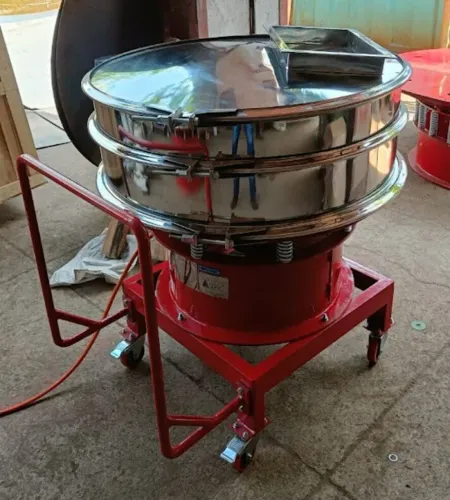
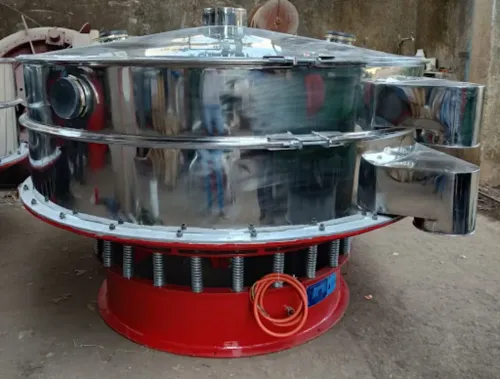
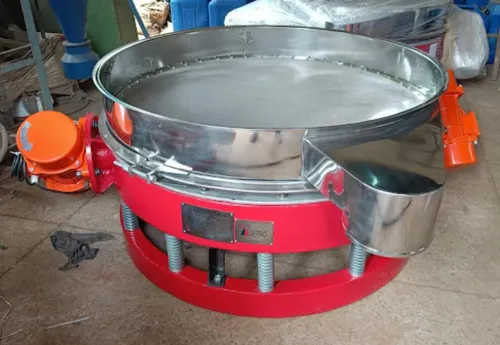
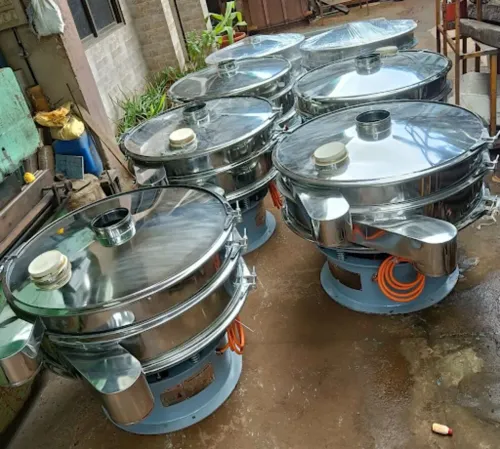
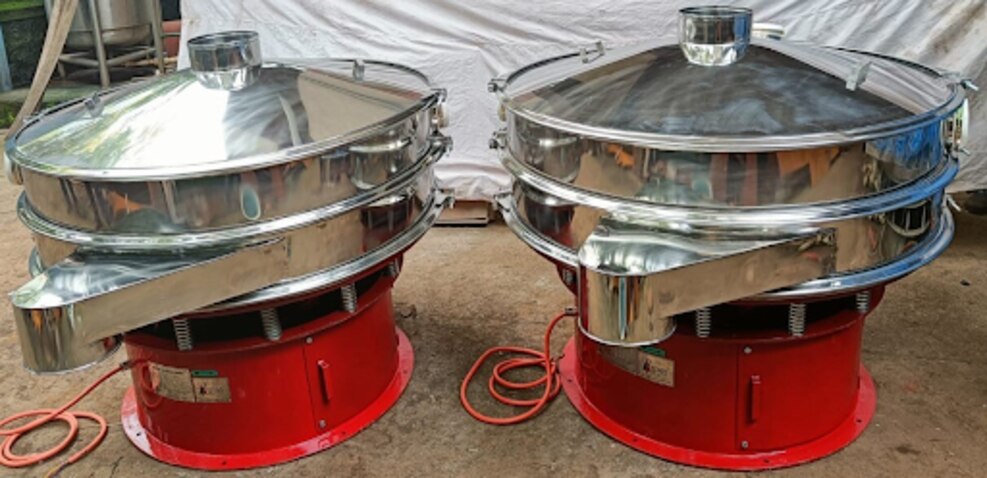
Choose the method by duty, not by equipment name. Use a manual sieve for laboratory checks, small batches, or emergency verification; it cannot provide production-rate control. Use a vibrating screen for continuous scalping, accurate classification, or multiple fractions.
A centrifugal sifter suits fine powder at higher throughput where rotating paddles force material through a cylindrical mesh. A rotary sifter suits gentle, enclosed screening of dry powder when the main duty is removing lumps rather than tight classification.
| Method | Best use | Main limitation |
|---|---|---|
| Manual sieve | Laboratory checks and occasional small batches | Slow, operator-dependent, no continuous dust control |
| Vibrating screen | Precise cuts, lump removal, and one or more fractions | Requires effective deblinding and vibration isolation |
| Centrifugal sifter | Fine powder and compact, continuous screening | Rotating parts add cleaning and maintenance points |
| Rotary sifter | Gentle scalping of dry powder | Less suitable for demanding, narrow particle-size separation |
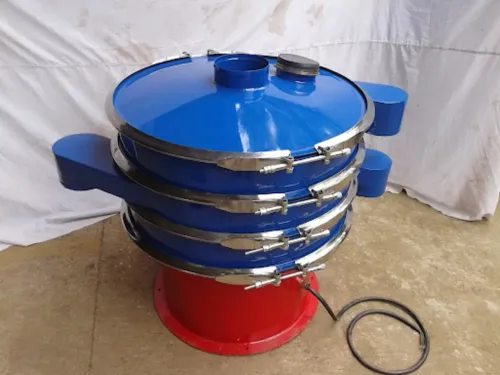
Start with one deck for lump removal or a single cut. Add a second deck only when one pass must remove coarse agglomerates and create a separate fraction; add more decks only with a mass balance for every outlet. Each extra deck increases inspection points, screen-change time, pressure drop, and cross-contamination risk.
Specify anti-blinding after a sustained product trial, not an initially clean-screen demonstration. Anti-blinding balls or sliders are simple but add wear and cleaning checks; bouncing rings reduce adhesion with similar sanitation concerns, while air-assisted or ultrasonic systems increase controls, noise, maintenance, and dust-management requirements.
Expect to combine features only when the supplier proves stable screening through the full production run.
Specify Food-Contact Construction, Cleaning, and Dust Safety
Specify 304 or 316L stainless steel for food-contact surfaces, with the grade recorded on drawings and material certificates. Set a measurable finish, such as surface roughness of Ra 0.8 μm or better, and reject pits, rough welds, internal ledges, exposed threads, and crevices that retain cocoa powder.
Screen choice affects both separation and cleanability:
| Screen type | Specify | Main risk to control |
|---|---|---|
| Woven stainless steel mesh | Aperture, wire diameter, open area, and applicable sieve standard | Torn wires or mesh bypass |
| Perforated stainless plate | Hole diameter, pattern, plate thickness, and open area | Poor accuracy near the target cut |
| Clamped removable screen | Continuous food-grade seal and tool-free inspection access | Leakage around the frame |
Do not order by “mesh” alone. State the aperture in millimetres or micrometres; two screens with the same mesh number can have different cut points. Specify how the frame prevents wire fragments, broken tensioning parts, and gasket pieces from entering the product, plus screen identification, integrity checks, and the response to a torn screen.
Require seals and gaskets that are food-compatible, captive where practical, and replaceable without leaving an exposed elastomer edge. Define dry-cleaning access, vacuum-cleaning points, inspection frequency, and wet-cleaning requirements; wet-cleaned areas need drainage and complete drying before cocoa returns.
Treat cocoa dust as combustible until a documented assessment proves otherwise. Include dust extraction, enclosure integrity, bonding and grounding, ignition-source control, and explosion venting, suppression, and isolation where the assessment requires them. An ordinary food-plant motor rating does not establish dust safety.
Use a Product-Specific Test Before Approving the Complete Installation
A machine that passes a factory demonstration can still fail on your cocoa powder. Require a witnessed test using representative production material, not a substitute powder, and run it at several feed rates within the proposed operating range.
1. Take samples of the feed, undersize, and oversize during each run. Record the feed rate, product temperature, bulk density, screen aperture, test duration, and screen-cleaning interval.
2. Require a sieve analysis using a named sieve standard, a stated sample mass, and a documented sieve stack. Define acceptance criteria in the contract: particle-size distribution, allowable oversize carryover, fines recovery, maximum noise level, and changeover time. State aperture in millimetres or micrometres, not mesh number alone.
3. Make the supplier show stable capacity at your required kilograms per hour, including peak demand. A single efficiency percentage proves little unless the sampling method and product specification are fixed.
4. Test integration as a complete assembly: inlet and outlet transitions, flexible connectors, aspiration take-off, controls, guarding, seals, lifting aids, spare screens, and hygienic access. Ask Separation Engineers (India) to document these interfaces rather than approving only the base screener.
5. Obtain electrical drawings showing voltage, frequency, enclosure rating, earthing, and destination-plant hazardous-area requirements. Require a dust-risk assessment and specified explosion protection for cocoa dust, including protective devices and venting or isolation arrangements where applicable.
Record validated dry-cleaning, wet-cleaning, reassembly, and dry-out procedures. Retained cocoa and incomplete drying can create hard deposits and microbiological risk.
Related product
 | Vibrating Screen Cocoa Powder Screening Machine The Cocoa Powder Screening Machine by Separation Engineers India is a high-efficiency, precision-engineered solution designed for the food processing... View product → |
Frequently asked questions
Why specify cocoa powder screen openings in micrometres or millimetres?
Mesh numbers alone do not define the separation. Specify the aperture, wire diameter, open area and sieve standard, such as ASTM E11 or ISO 3310-1, because screens with the same mesh designation can separate differently.
What cocoa powder properties affect screening machine selection?
Check particle-size distribution, bulk density, moisture, fat content, temperature, agglomeration and feed rate. These properties influence flow, screen loading, blinding and the capacity the machine can maintain.
Which deblinding system is suitable for cocoa powder?
Choose the system after testing the actual cocoa powder. Ball decks, sliders, ultrasonic deblinding or other methods differ in how they clear apertures without damaging the product or contaminating food-contact surfaces.
What should a food processor verify before approving the installation?
Verify the food-contact material, weld and surface finish, access for cleaning, dust containment, earthing, guarding and the product-specific test results for capacity, fraction quality, oversize carryover and screen blinding.