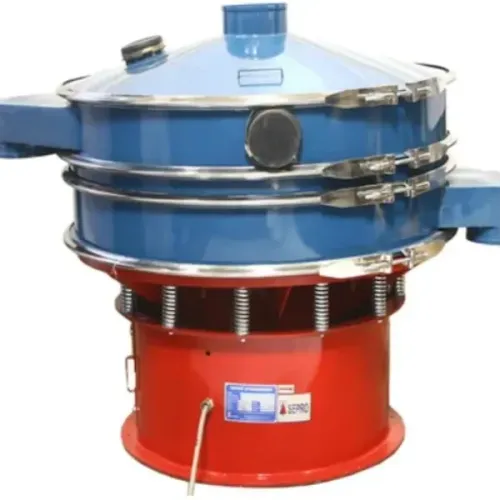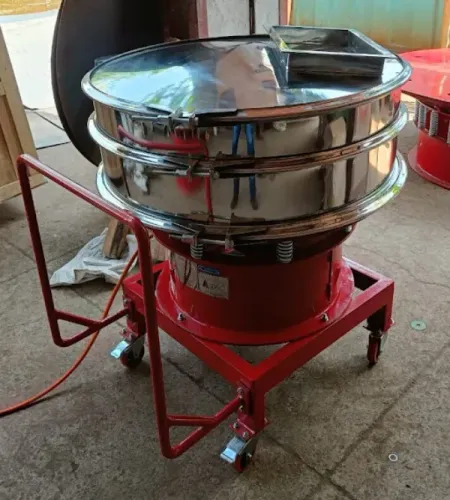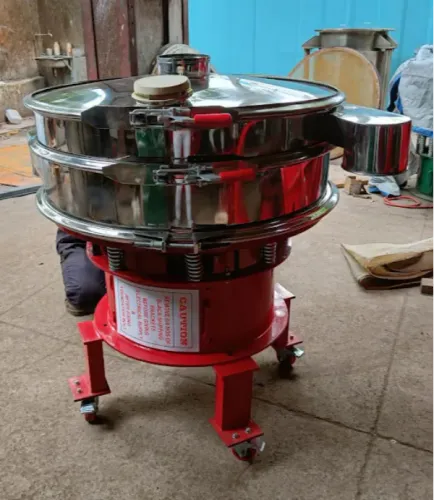


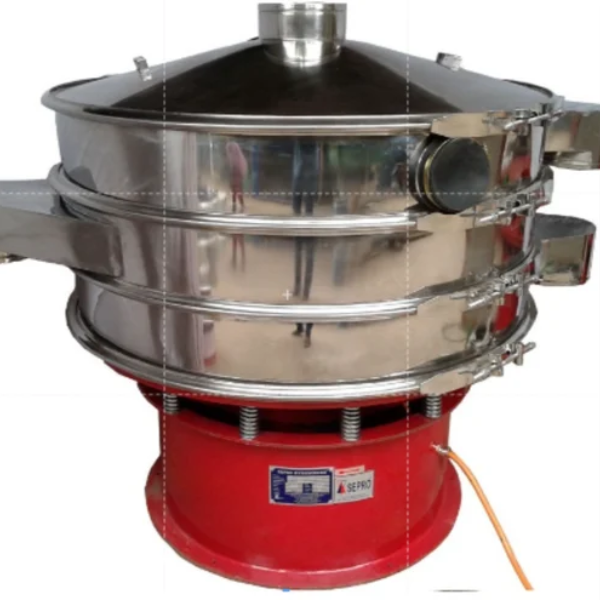
Recycled and processed glass can contain a broad mixture of particle sizes. Depending on the application, material may include fine glass particles, crushed pieces, oversized fragments, and particles that need classification before further processing.
A Glass Screening Machine helps separate these fractions according to defined size requirements. This makes screening relevant to businesses handling crushed glass, glass cullet, processed glass particles, and related industrial materials.
Industrial units in Navi Mumbai and across Maharashtra may use screened glass in different downstream applications, making accurate size classification an important part of material preparation.
Understanding Glass Screening Machine Applications
Screening does not change the chemical properties of glass. Its role is physical separation.
Material is introduced onto a screening surface with openings selected according to the required particle range. Smaller particles pass through the mesh while larger particles are retained.
Depending on the processing objective, a system may be configured to produce one separation point or multiple size fractions.
Typical applications can involve:
- Removing oversized fragments
- Separating fine material
- Classifying crushed glass
- Preparing material for downstream processes
- Improving particle-size consistency
- Recovering usable fractions from mixed material
The exact screening requirement depends heavily on what happens to the glass after classification.
Particle Shape Influences Screening Behaviour
Glass particles are not always spherical or uniformly shaped. Crushed material can include irregular, angular, elongated, and flat pieces.
This matters because two particles with similar overall dimensions may behave differently when they encounter a screen opening.
The screening process should therefore be evaluated using actual material characteristics rather than relying only on a nominal particle-size specification.
Capacity Needs a Practical Definition
Production teams often describe requirements simply in kilograms or tonnes per hour. Capacity is important, but it should be considered alongside separation accuracy.
A system that moves material quickly but produces poorly classified output may create additional downstream work. Conversely, an unnecessarily restrictive screen can reduce productivity.
Useful capacity discussions include:
- Expected feed rate
- Bulk density
- Desired cut size
- Number of fractions required
- Material condition
- Acceptable retained material
- Downstream process requirements
These details provide a much clearer basis for equipment planning.
Wear Management Deserves Attention
Glass is abrasive, and repeated contact can influence the condition of screening surfaces and other components.
Routine inspection helps identify screen wear before it begins affecting classification quality. Maintenance teams can monitor mesh condition, fastening points, product-contact surfaces, and unusual vibration during operation.
Preventive inspection is particularly useful in continuous production environments where unexpected downtime can interrupt several connected processes.
Screening Quality Begins With the Process Requirement
The most useful starting question is not simply which machine is available. It is what particle fractions the process needs to produce.
A glass processor may need to remove fines, recover a particular size range, separate oversized pieces, or prepare material for another production stage. Each objective can lead to different screening requirements.
Manufacturing companies in Navi Mumbai, Maharashtra, can use representative material samples and realistic production data when evaluating glass screening equipment. This helps ensure that screen selection reflects actual plant conditions.
When particle characteristics, throughput, screen opening, wear considerations, and downstream needs are assessed together, glass screening becomes a controlled classification process rather than merely another material-handling step.